Designing and developing a web platform to makes a small Alberta research institute feel as big and institutional as its work
Parkland Institute

| Website | parklandinstitute.ca |
|---|---|
| Domain | research |
| Region | Alberta, Canada |
| Main offices | Edmonton, AB |
| Size | 5-6 staff |
Overview
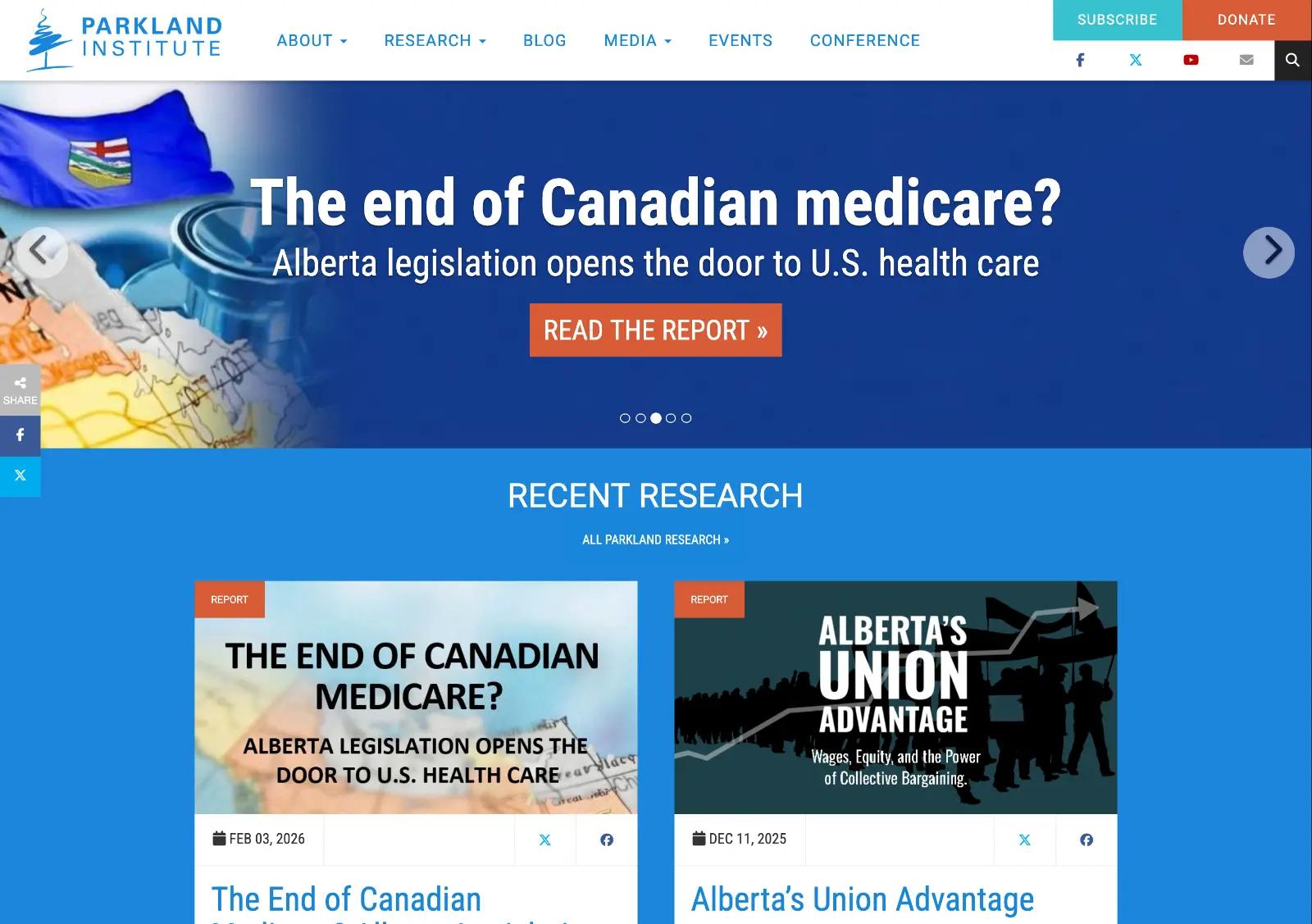
Parkland Institute is an Alberta-based, non-partisan research centre at the University of Alberta that examines how power, wealth, and public policy shape the lives of Albertans through a political economy lens. In 2015–2016, I began work with Parkland to redesign and rebuild their web presence so that their online footprint matched and elevated the importance, seriousness and rigour of their research— in a province where political leaders have occasionally tried to undermine the Parkland’s legitimacy.
Equally crucial to this work was setting up the Parkland on a platform to make it easier to connect them with their audience (Nationbuilder), to expand the attendance of Parkland’s long-running fall conference, for which we built a companion website.
I worked with the Parkland communications team in leading the development and design of the new website, treating the project as an opportunity to extend Parkland’s research “brand” into a fully realized digital experience rather than just a visual reskin. I designed a low-motion front end that feels sober and institutional, emphasizing typography, hierarchy, and clarity so the work reads as rigorous and trustworthy rather than flashy or partisan. At the same time, I developed the site for maximum engagement: strategic calls-to-action, clear sign-up and donation pathways (within their constraints), and multiple touchpoints for visitors to stay connected to Parkland’s work.
The site is built entirely on NationBuilder, which is frequently used for campaigns but less often pushed into the role of a long-lived research hub. I maxed out NationBuilder’s Liquid templating system to create a completely custom theme that fit Parkland’s needs instead of default campaign patterns. That included custom layouts for reports, commentary, and media content; flexible content blocks for campaigns; and page types tuned to how Parkland’s staff actually publish and maintain material.
Because Parkland hosts an annual fall conference, we also needed repeatable infrastructure that could support each year’s theme without a full rebuild. I designed and developed a turnkey companion conference site—also on NationBuilder—that can be cloned and adapted annually, with reusable structures for program schedules, speaker lineups, registration, and promotional content. Each year, I collaborate with Parkland staff to refresh this site for the new conference, refine workflows, and make incremental improvements based on what we learned the year before.
One of the trickier parts of the build was that Parkland cannot directly use NationBuilder’s financial tools; all transactions must run through the University of Alberta’s systems. That meant designing flows that move people off-site for payment while still feeling coherent and intentional. I worked with Parkland to map those constraints into user-friendly journeys, with clear context, wayfinding, and follow-up so that visitors understand where they are and why—without feeling like they’ve fallen out of the experience.
Alongside the web work, I also designed and tested email templates so that Parkland’s newsletters feel like a seamless extension of the site. I created flexible, responsive templates and stress-tested them across major email clients to make sure typography, layout, and calls-to-action held up in real inboxes, not just in a design tool. This helped turn their email list into a reliable engagement channel that matches the tone and credibility of the website.
The result is a long-term, collaborative relationship. Parkland and I have worked together over multiple years to evolve both the main site and the conference companion, improving editor workflows and audience engagement while keeping the overall aesthetic grounded and institutional. A staff member once described the site by saying, “I love the website — it makes us bigger than we actually are” — which is exactly the goal: digital infrastructure that matches the scale and seriousness of the work, even for a small team.